As November approaches, it’s hard not to get excited about the vibrant images that fill our minds—Thanksgiving dinners bursting with joy, thrilling football rivalries, and the enchanting start of the Christmas season. But before we dive into those festivities, let’s take a moment to honor a truly important day: Veterans Day on November 11th. Texas proudly hosts 15 active military bases, representing all branches of the military.
Another noteworthy celebration in November, though perhaps not as widely recognized, is the birthday of the Marine Corps on November 10th. This esteemed branch was established 250 years ago in Philadelphia through a resolution from the Second Continental Congress as our nation’s maritime land force.
The year 2025 marks a particularly momentous occasion! Across the country, public events will celebrate this significant anniversary. A specially minted half-dollar coin also salutes this milestone. The highlight will be the grand 100th Marine Corps Birthday Ball, scheduled for November 10, 2025, at the Bellevue Hotel in Philadelphia (where the first ball was held).
Yet, the most inspiring stories come from the courageous Marines who have dedicated their lives to our freedom. I recently spoke with Brian Koch, a proud Texan and veteran, who shared heartfelt insights into his service. Stay tuned for his remarkable journey!
“I enlisted in the United States Marine Corps on August 27, 2001, just two weeks before the September 11th attacks. At the time, I thought I would spend my four years of service during a period of peace, never imagining that my enlistment would soon lead me into combat. Everything changed when the nation was thrust into war, and by February 2003, I was deployed overseas.
From Kuwait, I entered Iraq on March 20, 2003, with India Battery, Third Battalion, 11th Marines out of Twentynine Palms. I served as part of the Fire Direction Control (FDC) element of our artillery battalion, responsible for coordinating the fire of six 155mm howitzer cannons. That role gave me a unique perspective on how our unit supported Marines on the front lines.
Just one year later, I deployed to Iraq again, serving a total of 13 months in the country over the course of two combat tours. During these deployments, I earned the Navy Achievement Medal, the Presidential Unit Citation, and the Combat Action Ribbon—recognition that reflected the sacrifices and challenges my unit and I faced together.
Although the experiences were difficult and demanding, I look back on them with pride. Serving my country during a time of war was an honor, and the lessons I learned and the bonds I built will stay with me for the rest of my life.”
Brian also gave insight to the importance of November 10th to him:
‘The Marine Corps birthday has always been special to me. It was the one time of the year we got to put on our dress blue uniform, show our ribbons and medals, and celebrate our history together.”
Thank you, Brian Koch, for your service to our country!
Brian is now happily married and a proud father of two wonderful children! Currently, his passion for making sourdough bread has blossomed into a delightful way to connect with neighbors and friends. He finds great joy in sharing a fresh loaf!
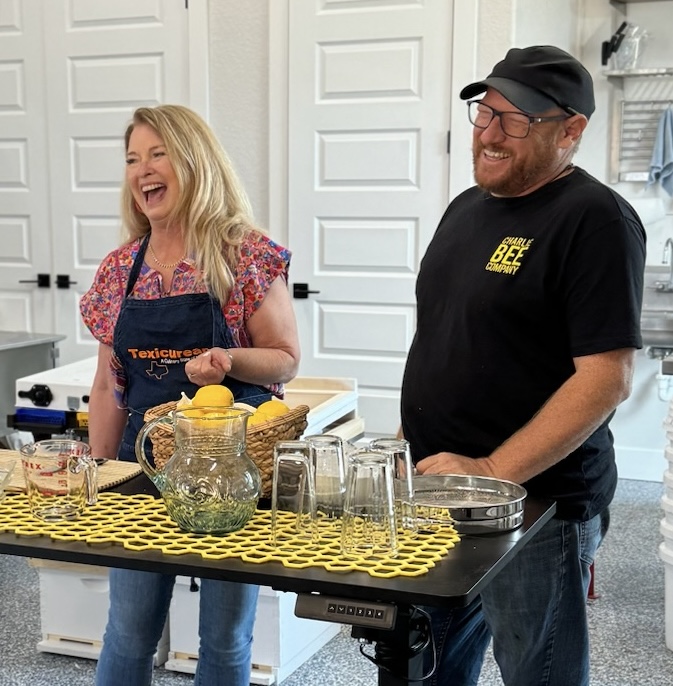
We recently gathered in the lovely Koch kitchen to uncover some of his secrets, and his enthusiasm for baking is truly inspiring. I can’t wait for you to try it out too! Here’s his tried-and-true recipe:

Brian's Sour Dough Bread
Ingredients
- 75 grams Active, bubbly (at peak) Sourdough Starter
- 350 grams Water
- 450 grams All Purpose Flour (11.5% Protein Content)
- 50 grams Whole wheat Flour
- 10 grams Fine Grain Salt
Instructions
- Mix your dough:Always prefer to start by adding the water, then the starter, and mix. In a separate bowl, measure out flour(s), and salt. Then mix in the wet ingredients. Work the dough until thoroughly combined; finish mixing by hand if needed. Scrap down the sides. Once finished, you should have a shaggy dough formed. This marks the start of "Bulk Fermentation." Cover with a lid, a hand towel, or plastic wrap. Let the dough rest for 30 45 minutes.
- Stretch & Folds:After 30-45 minutes, begin the first set of stretches and folds. Wet your hands to make it easier to work with the dough. Start by grabbing part of the dough at the edge, giving it a nice stretch upward, but avoid tearing the dough, fold it over into the center. You can rotate the bowl as you go, but ! typically like to do this on all four sides of the dough, 2 times around. For about a total of 8 stretches. You'll notice the dough start to firm up compared to when you first started the set. Depending on the temperature of your dough, you can adjust the time between stretch and folds. For warmer dough, I recommend doing a set of folds every 25-40 minutes. For cooler dough, every 45-1 hour, this allows the dough to relax between each set fully. You'll want to do a total of 3-4 sets during bulk fermentation.
- Bulk Fermentation:Perhaps one of the most difficult steps to understand, but it will come with time. The time of Bulk Fermentation (BF) widely varies based on the temperature of your dough and your home. As well as other environmental factors, like humidity and the seasons. It can take anywhere between 4-12+ hours to ferment. Here are a couple of time and temperature typical timeframes I find in my home: When my dough is around 76F degrees it roughly takes 7 hours to bulk ferment. When it's cooler, around 70Fdegrees, I find it takes around 10 hours to bulk ferment. If your home and dough is cooler I would wait longer, even possibly overnight. If your home and dough is warmer, l'd try shortening that time. This is when I would use my food thermometer to write down my dough's temp, making note of how long it took and the outcome, so you can adjust your time as needed. In time, you will learn to read your dough.ISome common signs that Bulk Fermentation has ended, can (but don't always include:)Jiggly Dough: Compared to when first mixed, the dough will be very jiggly when you shake the bowl.Bubbles: Bubbles can (not always) form along the top of the dough. If you use a glass bowl, you can see the dough change along the sides/bottom.The surface of the dough will be less sticky. When touching the top of the dough, it should not transfer/stick to your finger.Dough will rise, appear puffy and airy, and should about double in size. If in a warmer home, (70F+ dough won't completely double in size, instead aim for a 30% rise.
- Once Bulk Fermentation is complete, gently gather your dough from the bowl and place it onto a clean, lightly floured work surface. With floured hands (and bench scraper if you have one) work the dough into a tight ball and let sit for 20 minutes. Sprinkle flour on top.5) Final Shape:With a bench scraper or your hands, lift the dough ball, then quickly flip it onto the lightly floured counter with the floured smooth side down. The bottom part of the loaf should now be up, exposing the sticky side.Shape into a round dough ball for the boule proofing basket. Start by pulling one side/edge of the dough up and toward the center without tearing, and push that side into the center so it sticks. Hold there with a finger while grabbing another side and bring it into the middle, on top of the other. Repeat with all edges until you have created a tight ball, with a seam in the middle. If there are any loose "ears" pointing out, grab and pull them into the center. Flip the dough back over and place it on the counter with the seam side down. Add more tension to your loaf by gently pushing and then pulling the loaf to and from you with your hands again, without tearing. While doing so gently tuck the outer layer/smooth side of the dough under itself. Sprinkle the top with flour and flour your proofing basket/lined bowl and then lift and flip into it. (The bottom should now be exposed.) So the loaf is upside down in the proofing basket. *Optional* Let the dough relax for 5-10 minutes and then stitch the loaf for extra tension. Stitching is essentially a mini version of shaping, all while keeping it in the proofing basket. As you see the dough relax and possibly come undone at the seam, you'll just grab the edges of the loaf and bring it back into the center. Pinch the edges together so they stick together.
- Second Proof:Also, sometimes considered the second rise. You have two options for this part. If you want to bake the same day, you can leave your loaf in the proofing basket on the counter for about 11/2 hours. I'd extend or shorten that time by about half an hour based on how warm or cold your home is. Or you can see "cold proof" for an alternate option.Cold Proof: You can also choose to place your loaf in the fridge instead of baking right away, this is the method | prefer as it is much easier to handle and score the loaf when it is cold! I recommend leaving it in there for a minimum of 8 hours up to 2 days.
- Preheat Oven:Preheat times can vary, but I prefer 475°F. Put your dutch oven in the oven, on the center rack, to preheat and let it preheat for an additional 30 minutes after the oven has come to temperature to get the dutch oven very hot.
- Parchment Paper:Once your loaf is ready to bake, cut your parchment paper slightly larger than your dutch oven so you can easily lower it into the pot by holding onto the corners of the parchment. Place your parchment paper over your proofing basket or bowl, place your hand over the parchment paper and flip the basket over, and gently set on the counter. The loaf should come out easily and not stick due to lining the basket with flour. Brush off excess flour.
- Scoring:Now you'll need your razor blade, bread lame, or knife. For the expansion score, you want it to be a deep, fast slice, (about 1/2" deep) all the way from the top down to the bottom of the loaf. On round loaves, I like to make 2 expansion scores, one from top to bottom, and then another from left to right. (Basically a large plus sign.) Keep in mind, if you let your loaf do a second proof on the counter instead of the fridge, it will be much harder to score and will possibly snag. If using your kitchen scissors, make 5 deep cuts on the top of your loaf.Using your oven mitts, take the dutch oven out of the oven and place it onto the stove top, remove the lid. Lower your loaf into the dutch oven using the parchment paper, replace lid, and then place dutch oven on your oven rack and bake for 22 minutes with the lid on. After the 22 minutes, remove lid and bake for an additional 15-20 minutes (or until the desired color). Remove from dutch oven using oven mitts and place on a cooling rack, and let cool for at least an hour prior to slicing, as the loaf is still baking inside and can have a gummy texture if cut into prematurely.
- The loaf is best kept on the counter for 2-3 days, properly sealed. Do not refrigerate. I recommend freezing leftovers. And that's it, you did it! Time to enjoy!